From AI availability to AI execution
For the past few years, the enterprise AI conversation has largely revolved around access. Do employees have access to generative AI? Has the organisation deployed an AI assistant? Are teams using copilots? Is the company experimenting with AI agents?
Those were reasonable questions when enterprise AI was emerging. But the conversation is changing. AI is becoming increasingly available, capable and embedded in everyday work. The strategic question is no longer simply whether an organisation has AI.
If AI is already available, why is so much enterprise work still dependent on manual coordination?
That is the Enterprise AI Gap.
AI can understand. But can the enterprise execute?
Modern AI can understand natural language, summarise documents, analyse information, answer questions, generate content, reason over complex information, classify requests, extract data and recommend actions. But enterprise work rarely ends with an answer.
Consider a customer asking, “Where is my order?” An AI assistant can answer. An enterprise customer-service process may also need to identify the customer, retrieve the order, check shipment status, determine whether a delay occurred, apply policy, decide whether compensation is permitted, update the CRM, notify the customer, escalate when required and record the interaction.
The intelligence required to answer the question is only one component. The actual business value lies in completing the workflow.
The Execution Gap
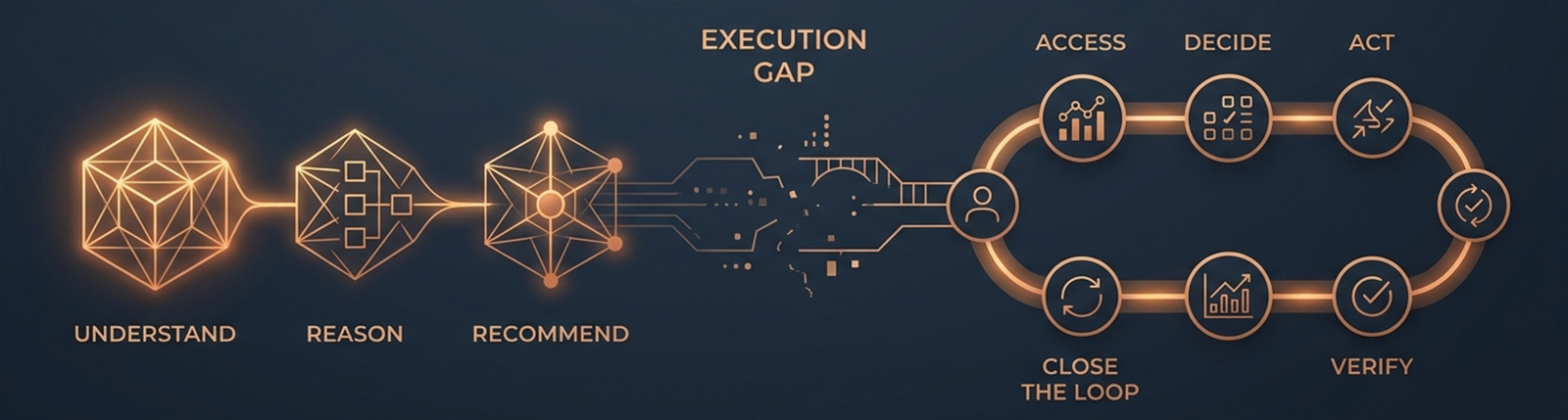
The NexZ framework illustrates the progression: Understand → Reason → Recommend → Access → Decide → Act → Verify → Close the Loop.
An AI model may understand a problem and recommend an action. But unless it can safely access enterprise systems, operate within business rules, involve people when necessary, take action, verify the outcome and close the loop, intelligence has not yet become enterprise execution.
The problem is not another AI model
Enterprises do not necessarily need another model. They need an execution architecture built around four layers: enterprise knowledge, enterprise systems, people and governance.
AI needs access to policies, procedures, product information, contracts, customer knowledge and organisational knowledge. It must connect with CRM, ERP, HR, finance, ticketing, procurement, inventory, communication and document systems. People remain essential for approvals, exceptions, high-risk decisions and escalation. Governance defines what AI can access, change, approve and execute.
From AI Assistants to Enterprise AI Execution
This is the shift NexZ is designed to address. NexZ positions itself as an Enterprise Execution Platform connecting People + Knowledge + Enterprise Systems + AI.
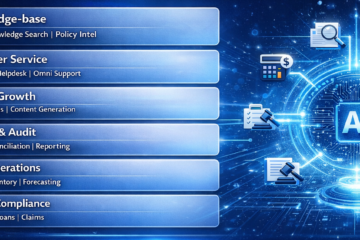
Across Customer Service, Sales & Growth, Finance & Audit, HR & Operations, and Legal & Compliance, the objective is to turn enterprise intelligence into measurable execution.
The new enterprise question
The old question was: “Where can we use AI?” The better question is: “Which workflows can AI help us execute end-to-end?”The future of enterprise AI is not AI everywhere. It is AI connected to work—and ultimately, AI that can execute.