
AI adoption is accelerating. Enterprise AI maturity is not.
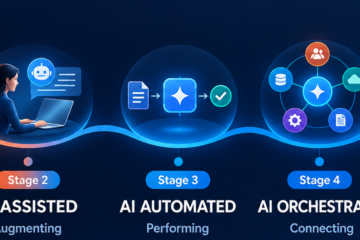
The NexZ AI maturity model presents five stages: Stage 1 — AI Curious (Exploring); Stage 2 — AI Assisted (Augmenting); Stage 3 — AI Automated (Performing); Stage 4 — AI Orchestrated (Connecting); Stage 5 — AI Execution (Executing).
The first two stages are relatively easy to enter. The difficult transformation begins after them.
Stage 1: AI Curious
The organisation explores AI through research, content generation, summarisation, brainstorming, translation and basic automation. The value is largely individual.
Stage 2: AI Assisted
AI becomes part of everyday work. Employees use it to draft emails, analyse documents, create reports, generate content, write code, summarise meetings, prepare proposals and answer questions.
But the human remains the primary coordinator: gathering information, moving between systems, checking records, deciding what to do, waiting for approvals, updating systems and verifying outcomes.
AI has improved the worker. It has not yet redesigned the work.
Why Stage 3 is harder
AI Automated means AI begins performing defined tasks or parts of workflows. This requires reliable data, system access, integration, rules, exception handling, security, monitoring and testing.
The organisation must move from “AI gives good answers” to “AI performs a business action reliably.”
Stage 4 is harder still
AI Orchestrated connects multiple systems, agents and people. An order workflow might run from Customer Inquiry → Understand Requirements → Customer Information Lookup → Product Information Lookup → ERP Validation → Missing Information → Clarification → Order Validation → Approval → ERP Update → Order Confirmation.
This is an operating-model challenge, not simply a technology challenge.
Stage 5: AI Execution
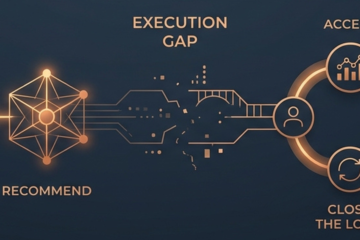
AI becomes part of the enterprise operating fabric: Understand → Reason → Access → Decide → Act → Verify → Close the Loop.
Why organisations get stuck
First, AI is deployed tool-by-tool, creating an AI tool landscape rather than an AI operating model. Second, enterprise data is fragmented across CRM, ERP, documents, email, inventory and HR systems. Third, workflows were designed for humans and contain spreadsheets, emails, manual approvals and disconnected systems. Fourth, governance is fragmented. Fifth, organisations often optimise tasks instead of outcomes.
The AI model is not the primary problem. The problem is connecting intelligence to the right enterprise context.
How organisations can move beyond Stage 2
- From AI tools → AI workflows
- From individual productivity → enterprise productivity
- From task automation → end-to-end workflow execution
- From AI autonomy → governed autonomy
- From experimentation → measured business outcomes
NexZ: The bridge beyond Stage 2
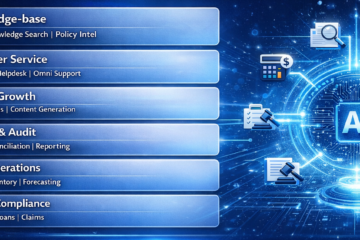
NexZ’s Enterprise AI Engine connects Knowledge + People + Enterprise Systems and enables AI-powered execution across Customer Service, Sales & Growth, Finance & Audit, HR & Operations, and Legal & Compliance.
The real maturity question is no longer: “Are we using AI?” It is: “Where is AI actually executing work?”