
From AI experiments to an enterprise operating model
Every major technology era eventually reaches the same strategic question: How does technology change the way the organisation actually operates? AI is now approaching a similar inflection point.
The greatest opportunity may not be AI as a standalone technology. It may be the emergence of the Autonomous Enterprise.
What is an Autonomous Enterprise?
An Autonomous Enterprise is not an organisation without people. It is an organisation where AI can independently execute appropriate parts of business workflows while people retain control over decisions requiring judgement, accountability or authority.
AI handles the routine. People handle the consequential. Systems provide the context. Governance defines the boundaries. Workflows connect everything.
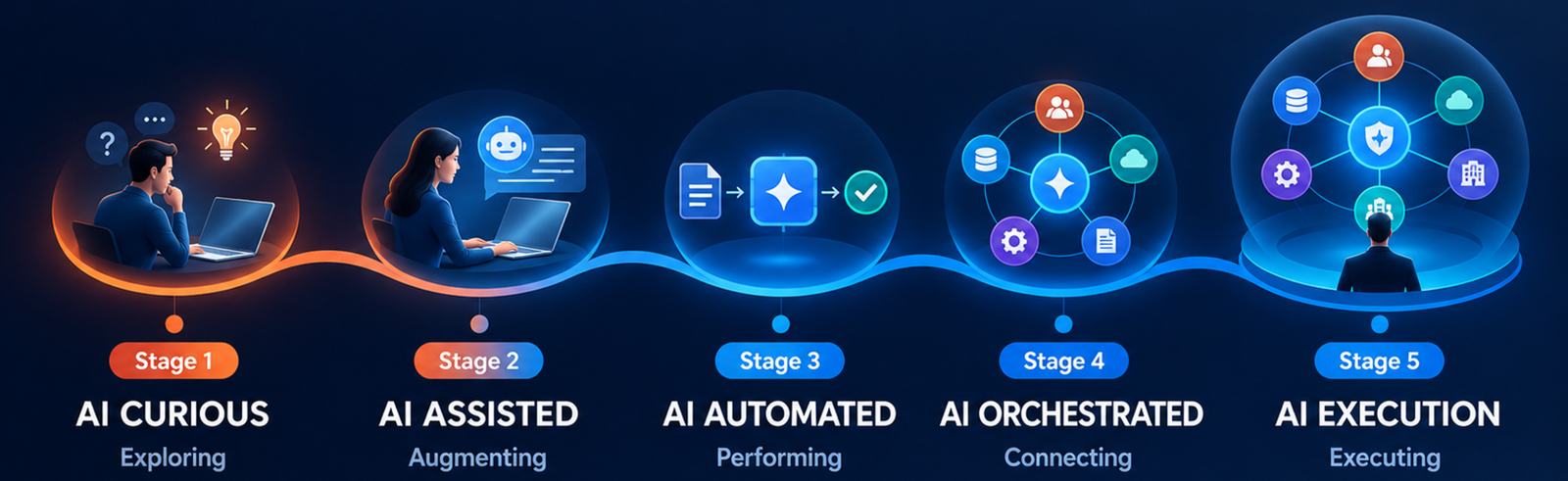
The journey from AI Curious to AI Execution
Stage 1 — AI Curious: employees explore research, content, analysis, summarisation and knowledge retrieval.
Stage 2 — AI Assisted: AI becomes a productivity layer, but humans still orchestrate the work.
Stage 3 — AI Automated: AI begins executing defined activities such as invoice reconciliation, CV screening, lead generation and customer-service classification.
Stage 4 — AI Orchestrated: multiple systems, agents and people become part of one coordinated workflow.
Stage 5 — AI Execution: AI can Understand → Reason → Recommend → Access → Decide → Act → Verify → Close the Loop.
The NexZ approach
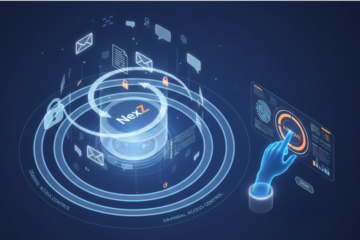
NexZ provides an execution layer connecting the three major assets of an enterprise: People, Knowledge and Enterprise Systems. At the centre is the NexZ Enterprise AI Engine, coordinating AI-powered workflows across enterprise functions.
Connect once. Execute everywhere.
From fragmented AI to a unified execution layer
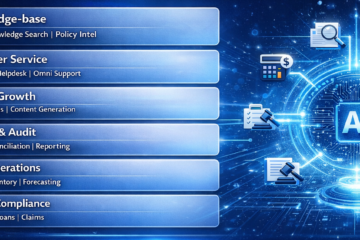
Without a common architecture, organisations can end up with separate AI tools for customer service, sales, HR, finance, documents and internal search. NexZ’s approach is to provide a common execution layer while allowing organisations to deploy modular AI workflows across functions.
The role of humans changes
Autonomous enterprise execution does not eliminate human involvement. It changes where human involvement creates the most value. People can spend less time copying information, checking routine records, moving data between systems, answering repetitive questions and manually routing requests—and more time on exceptions, strategic decisions, customer relationships, innovation, complex negotiations, risk management and leadership.
The path requires more than technology
- Map the workflows — Identify workflows that create the greatest business impact.
- Identify friction — Find manual work, delays, duplicated effort, disconnected systems, unnecessary approvals and data inconsistencies.
- Determine AI’s role — Decide where AI should understand, recommend, automate, orchestrate or execute.
- Connect enterprise systems — Give AI access to the information and systems required to perform the workflow.
- Introduce human governance — Define approval thresholds, permissions, escalation rules and accountability.
- Measure outcomes — Track cycle time, cost, productivity, error rate, resolution rate, conversion, customer experience and employee efficiency.
- Scale — Reuse proven execution architecture across departments.
The Autonomous Enterprise is a journey
The journey can begin with one workflow, such as Invoice Reconciliation, and expand to Procurement, Inventory, Supplier Coordination, Customer Orders and Customer Service. Eventually, multiple workflows can operate through a common AI execution layer.
Enterprise autonomy becomes practical not through one giant transformation project, but through progressive workflow transformation.
The ultimate competitive advantage
The next competitive advantage will not necessarily belong to the organisation with the most AI models or pilots. It will belong to organisations that can turn AI capability into repeatable, governed, measurable execution.
That requires Intelligence + Integration + Execution. Together, these create something greater than an AI assistant: an Enterprise Execution Platform.
The NexZ vision
AI Curious — Explore → AI Assisted — Augment → AI Automated — Perform → AI Orchestrated — Connect → AI Execution — Execute.
The objective is not to make AI smarter. It is to make the enterprise more capable of acting on intelligence.
That is ultimately the path from AI adoption to enterprise transformation.