
Why autonomous execution must be designed with control
The word autonomous has become one of the most attractive—and most misunderstood—terms in enterprise AI. An AI agent that can reason, use tools and execute actions sounds powerful. But enterprise environments are different from consumer environments.
A mistake in an enterprise workflow can create financial loss, compliance exposure, incorrect customer communication, contractual consequences, operational disruption, privacy violations and reputational damage.
The goal cannot simply be: Make AI autonomous. The goal must be: Make AI appropriately autonomous.
Autonomy requires boundaries
Consider an AI agent processing an invoice. What if the amount exceeds a threshold, the supplier is new, the purchase order does not match, bank information has changed, the invoice violates procurement policy or confidence is low? The answer is controlled autonomy.
Low-risk: Understand → Validate → Execute → Verify. Medium-risk: Understand → Validate → Recommend → Human Approval → Execute → Verify. High-risk: Understand → Analyse → Recommend → Escalate → Human Decision → Execute → Verify.
Governance should be part of the workflow
Governance cannot be an afterthought. It needs to exist inside the execution architecture. NIST’s AI Risk Management Framework identifies trustworthy AI characteristics including accountability, transparency, security, privacy, explainability, reliability and fairness.
Enterprise governance should answer: What can AI access? What can it change? Which actions require approval? What confidence threshold is acceptable? Which data is sensitive? What happens when AI is uncertain? Who is accountable? Can decisions be audited? Can actions be reversed?
Human-in-the-loop does not mean human-in-everything
AI handles what can be safely automated. Humans handle what requires judgement, authority or accountability.
AI can handle document extraction, classification, data comparison, policy lookup, customer-context retrieval, routine communication, data validation and workflow routing. Humans can handle exceptions, sensitive approvals, strategic decisions, unusual customer situations, high-value transactions and regulatory judgement.
Governance is not the opposite of autonomy
Good governance defines the conditions under which autonomy is allowed: Knowledge → Reasoning → Policy / Guardrails → Decision → Authority Check → Action → Verification → Audit Trail.
NexZ and governed execution
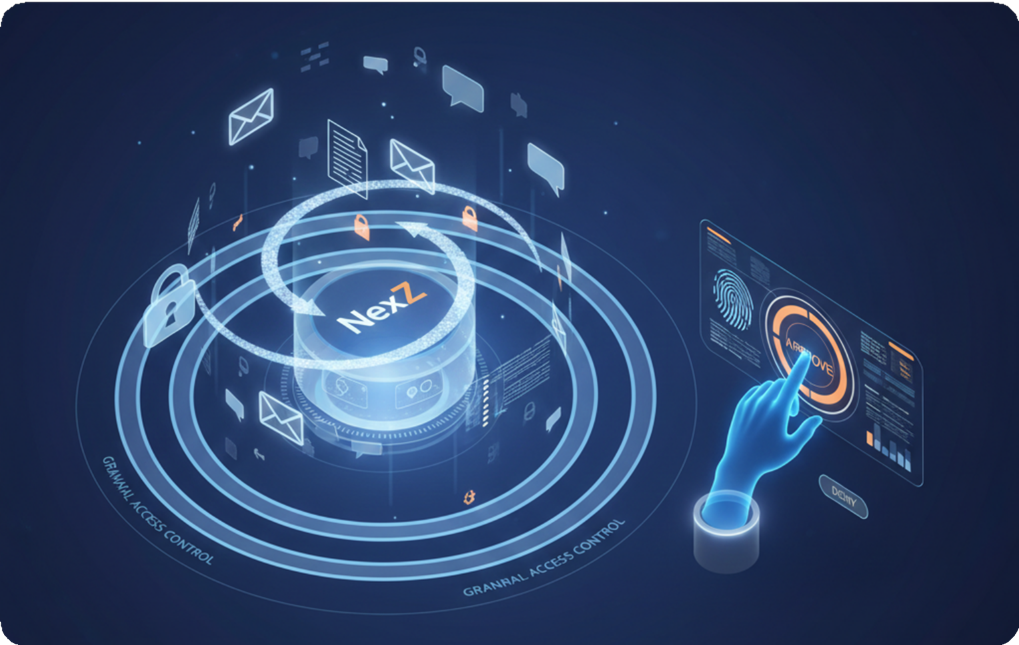
NexZ’s enterprise execution model connects AI + Enterprise Knowledge + Enterprise Systems + People. Organisations can define where AI can read, recommend, approve, act, escalate and verify.
In customer support, AI can prepare a response while a support manager reviews, edits, approves or rejects it. In finance, AI can reconcile invoices while exceptions go to authorised personnel. In HR, AI can screen and rank candidates while final hiring decisions remain with responsible humans.
The enterprise AI maturity test
- What decisions can AI make?
- What actions can AI execute?
- What actions require human approval?
- What happens when AI is uncertain?
- How are actions verified?
- How is accountability maintained?
- Can every important action be traced?
Automate the predictable. Escalate the exceptional. Govern the consequential. Verify the outcome.